
Fields in Oglethorpe Tax Records
Oglethorpe County property tax records split into two halves. The valuation half lives with the Tax Assessor. That office's parcel card holds the details that drive an appraisal: ownership for tax purposes, situs and mailing addresses, acreage, property class, land and improvement facts, homestead status, tax district, and values. The collection half belongs to the Tax Commissioner's property service. That office tracks bills, due dates, payment status, and delinquency. Read the two together and the full tax picture emerges.
| Field | What It Shows | Where |
|---|---|---|
| Fair market value | County estimate of full value | Assessor parcel card |
| Assessed value | Taxable assessment before exemptions | Assessor parcel card |
| Land and improvements | Separate property components | Assessor parcel card |
| Class and exemptions | Tax treatment and relief flags | Assessor parcel card |
| Bill and status | Charge, due date, payment, or delinquency | Tax Commissioner |
Georgia assesses most property at 40 percent of fair market value. That ratio is a starting point, not an appraisal. It will not predict a sale price. Exemptions can cut the taxable amount further. A bill reflects whatever rates and tax treatment applied that year. So read its figures next to the assessment notice behind them.
Always carry the tax year with a figure. A current payment screen, an older bill, and a new assessment notice can all be valid at once. They can still disagree. The parcel number is the safest cross-reference. Use it when an owner name, mailing address, or street label has changed.
Read the Oglethorpe Parcel Card
The county's qPublic search takes an owner name, location address, parcel number, or legal information. Local parcel keys follow no single obvious pattern. Public examples include a spaced number, a lettered number, and a compact number. Copy every character exactly.
A documented parcel card shows why each field matters. It keeps the owner and mailing address apart from the location address, then lists acreage, class, district, homestead, improvement facts, and value. A class such as conservation use is tax treatment, not zoning. Zoning questions go to county Planning.
The local sample adds land and improvement details, a tax district, and a millage field. Treat it as a model of the fields. Open the official card for the parcel and year you actually need.
| Search key | Best use | Watch for |
|---|---|---|
| Owner name | Find parcels on the roll | Name variants and entities |
| Location address | Known site search | Situs differs from mailing |
| Parcel number | Exact cross-reference | Spaces and letters matter |
| Legal information | Subdivision or description clue | Not a deed substitute |
Oglethorpe's Forty Percent Rule
The Georgia Department of Revenue lays out the statewide assessment level. Fair market value is the assessor's estimate. It reflects what a property would bring in a fair sale. Assessed value sits at roughly 40 percent of that figure. The roll then layers on exemptions and special classifications that shape the taxable amount.
Land and improvements often appear separately. That split helps an owner trace a change. Was it acreage, building data, or both? It stops short of what a private appraiser would weigh, though. Recent condition, private concessions, and a buyer's terms rarely appear. They seldom surface in Oglethorpe County property tax records.
Fair market, assessed, taxable, and sale figures are easy to confuse. See the dedicated Oglethorpe property value discussion. Tax records then add the bill, rate, exemption, and payment layer.
Look Up an Oglethorpe Tax Bill
Pull the parcel card first. Write down the exact parcel number, then carry it into the payment system. The GovernmentWindow tax page sits behind a verification prompt at times, so plan on other routes too: the public property page, a phone call, email, mail, or the counter in person.
- Find the parcel in qPublic by location address and copy its parcel key.
- Open the Tax Commissioner property lookup and enter the best supported key.
- Compare the bill with the assessment, tax district, classification, and exemptions on the parcel card.
- If a year or status is unclear, call 706-743-8422 or request that exact parcel and tax year from the office.
- Assessed value
- The value produced by applying Georgia's assessment level to fair market value.
- Millage or levy
- The rate used with taxable value to calculate tax.
- Homestead exemption
- Tax relief that may apply to a qualifying principal residence.
- Tax lien
- A public claim tied to unpaid tax, distinct from a mere overdue bill.
Oglethorpe Tax Portal Fallbacks
The online systems are not the only channel. The Tax Commissioner sits at 339 West Main Street in Lexington, with mail received at PO Box 305. Hours run weekdays from 8 a.m. to 5 p.m., closing Friday from noon to 1 p.m. for lunch. Call 706-743-8422 or write taxcommissioner@oglethorpecountyga.gov with questions.
The county property-tax page is the clearest web fallback. It displays the county's property-tax entry point and the record categories the Tax Commissioner maintains.
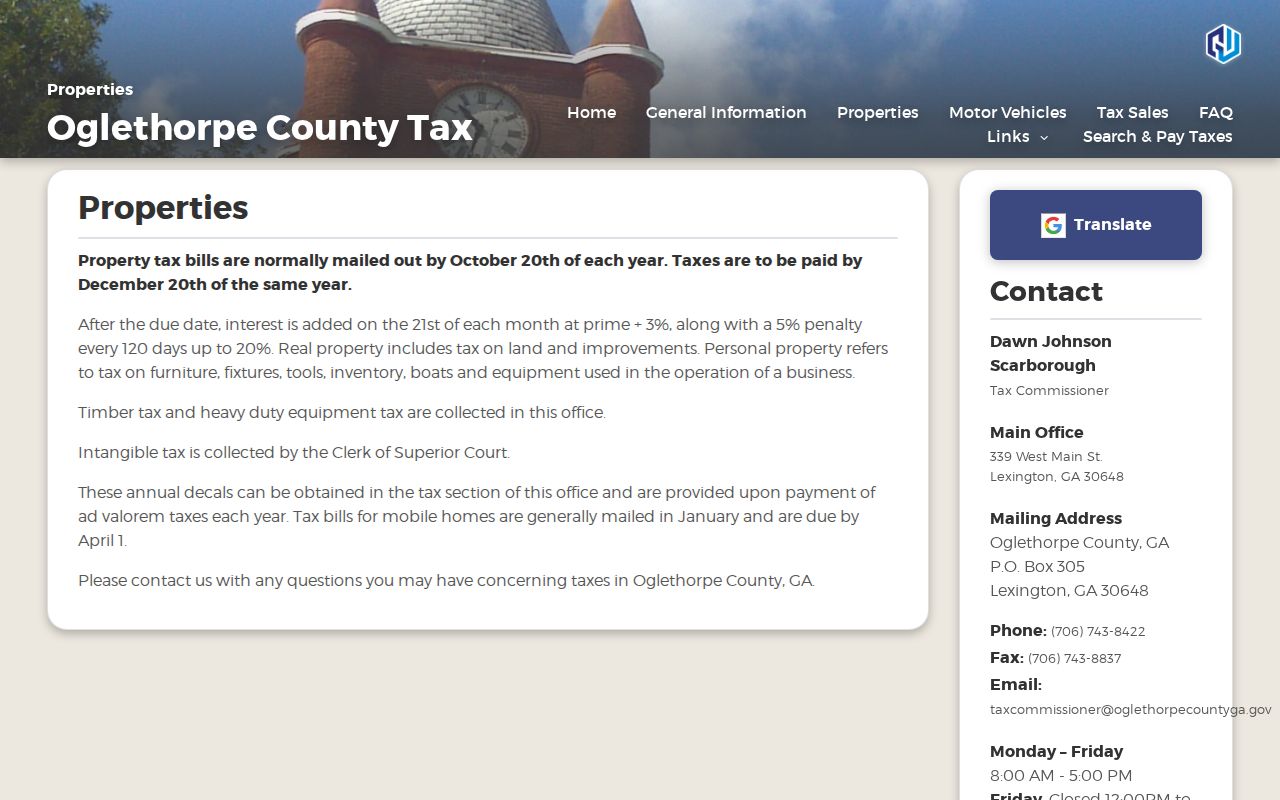
That page is a starting point, not proof a bill is current. Confirm any unclear balance with the office and cite the parcel and tax year. GovernmentWindow offers another official path; its tax-search screen uses the same verification gate for unattended lookups.

The barrier does not make the record private. Phone, email, mail, or an in-person request is simply the sound next step.
Oglethorpe Bills and Delinquency
Oglethorpe County bills real property on a strict calendar. Bills mail by October 20. Payment is due December 20. Miss that date and costs climb quickly. Interest accrues on the twenty-first of each month at prime plus three percent. A five percent penalty lands every 120 days, capped at 20 percent. Penalties stack this way. So a bill's payment status matters as much as its amount when you review Oglethorpe County property records.
An old notice in the Oglethorpe Echo proves nothing about today. Legal notices can hand you a parcel number, deed book, plat reference, sale authority, or redemption hint. But only the live Tax Commissioner record and recorded deed records settle whether a parcel is still delinquent. A February 2024 tax-deed and redemption notice, for instance, bundles a parcel key with deed and plat references. That is a courthouse search trail, not an answer. It cannot tell you whether redemption followed. It cannot say whether a release was recorded, or who holds title now.
Verify before relying. A published tax-sale or redemption notice is a dated lead, not proof of today's balance or title.
Special Oglethorpe Tax Accounts
Property tax in Oglethorpe County reaches past the standard house and lot. The Tax Commissioner also bills mobile homes, timber, and heavy-duty equipment. Mobile-home bills run on their own clock, mailing in January and coming due April 1. Real property means land and improvements. Personal property can include furniture, fixtures, tools, inventory, boats, and equipment.
Intangible tax belongs to the Clerk of Superior Court instead. Naming the record type up front keeps a request from landing at the wrong desk. One parcel may carry a home, business assets, and timber activity. No single account covers them all. So ask for the specific account and year. A real-property parcel search will not surface a mobile-home account or taxable equipment. A receipt only shows a charge was paid. It never shows that the assessor's classification behind it is correct.
Oglethorpe Exemptions and Classes
Exemptions shape what an Oglethorpe County tax bill actually says. The Georgia homestead exemptions resource lays out statewide relief. That includes programs tied to age or disability where eligibility applies. On the local parcel card, look for a homestead code or a conservation-use class. Those flags change tax treatment. They do not prove title, occupancy on the day of search, or zoning.
Before any filing deadline, ask the Oglethorpe Tax Assessor which form and proof apply. The office sits at 341 West Main Street in Lexington. Phone service is 706-743-5166, and email is taxassessor@oglethorpecountyga.gov. Frame the request narrowly. Give the parcel key and name the exemption or class in question.
When Oglethorpe Appraisers Visit
Oglethorpe County appraisal staff make field visits under O.C.G.A. §48-5-264.1. Their work lines up with tax returns and appeals. It also covers new construction, conservation-use reviews, and routine parcel checks. On site, they may measure structures, gather construction details, and photograph improvements. Ask for photo identification. Staff should also arrive in a marked county vehicle. If anything about a visit seems off, a call to the assessor settles it quickly.
These visits explain why property records can shift without any sale. A revised measurement can move the tax roll. An acreage correction can do the same. So can a classification change. When the resulting parcel data looks wrong, the assessor's office is the place to ask.
Note: An appraiser's visit is appraisal work only; it never transfers ownership or replaces a recorded deed.
Contest an Oglethorpe Assessment
An owner can appeal value, uniformity, taxability, an exemption denial, or a breach of covenant. Georgia allows 45 days from the assessment notice date. The PT-311A appeal form is the state entry point. Filing and local review run through the Oglethorpe County Board of Tax Assessors.
Strong support includes the notice, corrected parcel facts, photographs, and comparable sales. Add a survey or plat where acreage is disputed, plus records of damage or condition. Keep proof of delivery. Retain copies of the bill, exemption filings, and appeal trail under the same parcel number.
Appeal window. File within 45 days of the assessment notice date; a tax-bill due date is not the assessment appeal deadline.
The state PT-311A page identifies the official appeal route. Check its current instructions before filing.
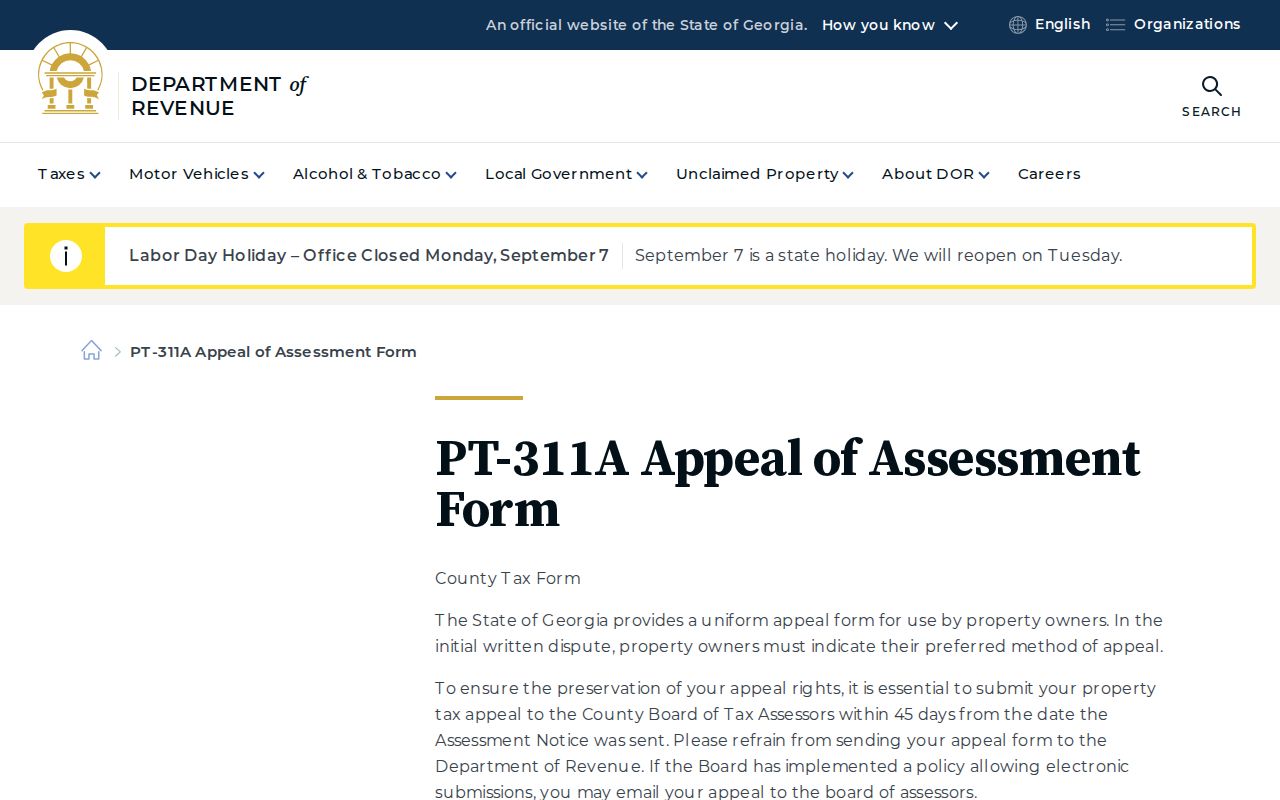
The form supports a challenge to an assessment. It does not replace a timely filing with the Oglethorpe County board.